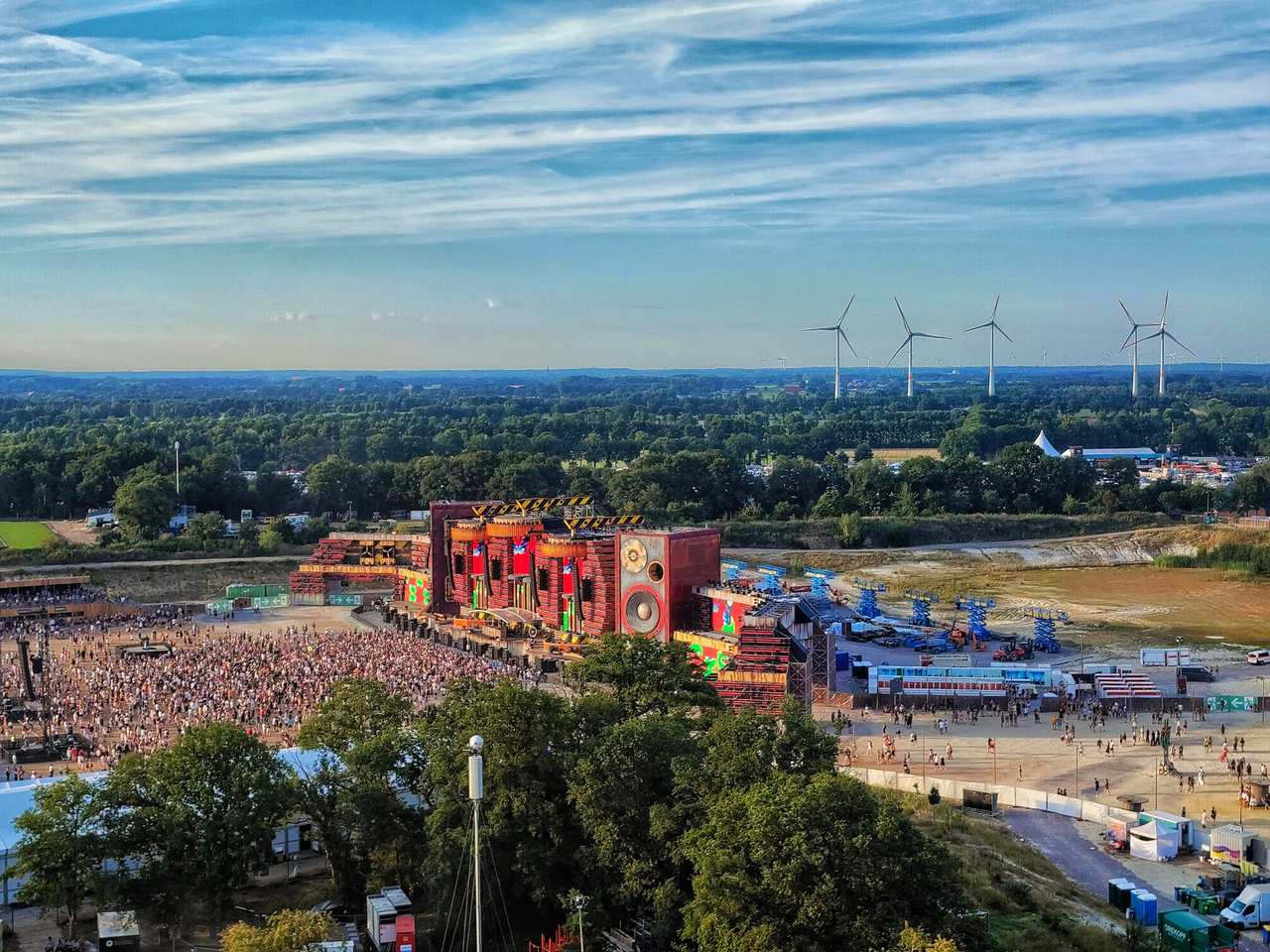
It is hard to imagine Tomorrowland in 2005 from what it looks like today.
The founders had hoped for at least 15,000 visitors. The brothers and their small team went around Flanders, Belgium, putting up posters at french-fry shops and pita stands. But only about 9,000 people showed up. The first edition lost money, and the following year and the year after were reportedly a struggle too. [1]
That event eventually became a place that people all over the world say they want to visit at least once in their lives.
What changed? Was it that the stages got bigger? That famous DJs were booked? That YouTube videos spread around the world?
All of these are part of the history, but if you pull them apart, the reasons for the success become harder to see. At Tomorrowland, music, stage design, video, travel and the memories of the audience were tied together over time.
Here we follow the changes year by year from 2005 to 2026, centered on the original Belgian festival. The years 2020 and 2021 were online editions, and the overseas editions are covered where they relate to the history of the main festival.
The eve of the founding: the brothers, ID&T and Belgium's dance culture
Tomorrowland was founded by the Belgian brothers Manu Beers and Michiel Beers. Its prehistory includes "Antwerp is Burning," which they put on in Antwerp. That track record led to a relationship with the Dutch event company ID&T, and the brothers came to be involved in the company's Belgian business. [2]
In other words, Tomorrowland did not suddenly appear in a land with no dance music. Local event-production experience and a cross-border network of promoters formed its foundation.
The idea at its core was to let people experience music in a place with sunlight, color and water to enjoy. The site chosen was De Schorre in Boom. The concept was to take the music people enjoyed in nightclubs at night and set it in an outdoor landscape. [2]
Nor was the name Tomorrowland from the start. According to Michiel's recollection, preparations were under way to use the name Mysteryland, and promotional materials had even been printed. But ID&T decided to keep that name in the Netherlands, so a new name was needed. He later looked back on this change as what gave Tomorrowland its own distinct identity. [3]
There was no finished global brand at the founding. Even with experience behind them, they had to establish their audience, their funding, and even their own name by themselves.
2005–2009: from a money-losing start to the first sell-out
2005: a one-day event that fell short of expectations, the start of a world-famous festival
The first Tomorrowland was a one-day event. [4] According to the trade outlet eventplanner, which relayed the founders' recollections, attendance was 8,700 and the loss on the first edition was about 128,000 euros. The fact that Tiësto's appearance did not come together is also mentioned as one of the early difficulties. [1]
The numbers contrast sharply with the glamorous image of later years. This is not a story of an instant hit whose profits paid for expansion. At least at the first edition, the demand they had hoped for did not turn into actual attendance.
2006: people who came once bring the next people
The founders recall that the second year also ran at a loss. They kept going all the same, and the official history records an expansion to eight stages and accommodation space. [1][4]
David Guetta performed this year. Spokesperson Debby Wilmsen later recalled that his rising popularity coincided with the festival's growth, and that word of mouth helped draw the early crowds. [2]
2007: two days at last, and a broad musical range from early on
In 2007 the festival was held over two days for the first time. [4]
A report from the site at the time describes the experience of audience members who, after listening to Armin van Buuren, moved on to the Kozzmozz area where Jeff Mills was playing. Within the same festival, you could move between trance and techno. [5]
This matters for avoiding the view of Tomorrowland as nothing but the big-room EDM of later years. From the beginning, it was a place that welcomed several music communities.
At the same time, that report also mentions rain, mud, and complaints about food and parts of the operation. The polish of the experience that later earned such high praise was not all there from the start. [5]
2008: Armin, Guetta, Carl Cox, and a festival welcoming about 50,000 people
The official history records an attendance of about 50,000 in 2008, making it a milestone in the early growth. [4]
The performance record for July 27 lists Armin van Buuren, David Guetta, Carl Cox, Dr. Lektroluv and Felix Da Housecat on the main stage. Armada had Above & Beyond and Markus Schulz, and Café D'Anvers had Sasha, Dubfire and Loco Dice. Q-dance featured names such as Headhunterz & Wildstylez and Showtek. [35]
Guetta, who would come to symbolize the later EDM boom, shared the bill with leading acts from trance, techno and hardstyle. Even before it grew huge, Tomorrowland had a deep lineup that you could not see from the main stage alone.
2009: Moby, the first sell-out, and a turning point in visual expression
In 2009 tickets sold out for the first time, and Moby's appearance also drew attention. [4]
The researcher Fabian Holt, in discussing Tomorrowland's shift toward long festival films, focuses on the 2009 work with Moby. He says that in the process of putting the performance on film, the approach to stage decoration, visual effects and filming developed. [6]
From promotion that announces who is performing and when it takes place, to video that conveys the sense of being there. Making the event and deciding how to film it begin to be linked.
This change is the key to understanding the international spread of the 2010s.
2010–2014: the era when music and YouTube connected the world
2010: Avicii and Swedish House Mafia resound, the entrance to the EDM heyday
The video published by Kemmer Media Group, the production company for that year, lists the tracks used: Avicii's "Bromance," Swedish House Mafia's "One," and The Bloody Beetroots feat. Steve Aoki's "Warp 1.9." [7]
Songs that lift you with big melodies, repeating synth phrases, the shock of rough electro. The appeal of the music later remembered as the "EDM heyday" was tied together with the festival's footage.
That said, the songs in an aftermovie are chosen for editing and are not a ranking representing every stage that day. What can be read from this is what kind of music the organizers wanted to use to convey their impression of Tomorrowland.
This video was also a trailer for the DVD. A keepsake for attendees and promotion to bring in next year's audience coexist within the same footage. [7]
▶ 2010 video: the production company's official "Post Event Movie"
2011: three days, and the audience itself conveys the festival's appeal
In 2011 Tomorrowland expanded to three days. [4]
That year's aftermovie is an important one when discussing internationalization through video. In Holt's research, the aerial views of the landscape and the joy of the crowd are analyzed as expressions that let viewers imagine the space and emotion of the festival. [6]
If only a big-name DJ is shown, it reaches that DJ's fans. But when audience members who are enjoying themselves appear on screen, then in addition to "I want to go to see that person," an interest can arise in "I want to be one of those people."
On the music side, the organizers recall that Avicii performed for the first time and played "Levels," before its official release, on the main stage. [37] It was also a year when a song that would later symbolize an era overlapped with the memories of the people who were there.
2012: a giant book becomes a shared image worldwide
The theme was "The Book of Wisdom." The stage centered on a giant book became Tomorrowland's emblematic design. [4][8]
The reach of that year's video is large. In a 2021 retrospective article, Tomorrowland says the 2012 aftermovie had reached 168 million views at that point. This is a cumulative figure as of 2021, not the view count right after release. [8]
The partnership with Brussels Airlines also began in the same year, 2012. [9]
Putting these two side by side shows the mechanism of growth. Video carried longing to people around the world, and that longing was made something they could act on as travel. Turning distant viewers into attendees required arranging flights, lodging and transport as well.
The explanation "it succeeded because the video went viral" misses the second half. Only when a route exists for people who learn about it to actually take part does international interest turn into on-site attendance.
2013: a festival that gathers people from the world goes out into the world
The theme was "The Arising of Life." This year TomorrowWorld began in Georgia, USA. [4][10]
In an interview at the time, Michiel explained that they had considered more than 100 candidate sites for the overseas edition. He stressed finding a place with a uniqueness comparable to Belgium's, and said that giving TomorrowWorld the same spirit and atmosphere as Belgium was "an obligation and a promise." [10]
According to a Brussels Airlines announcement the same year, the 13,000 Global Journey travel packages that the airline and Tomorrowland prepared sold out in a few hours. The movement of going out into the world and the movement of welcoming the world to Belgium were proceeding at the same time. [9]
As a musical memory, there is also the moment when Armin van Buuren announced the birth of his son from the main stage. He himself later looked back on it as one of his unforgettable moments at Tomorrowland. [11]
A festival's history cannot be made from facilities and attendance figures alone. Moments when the lives of performers overlap with the memories of the audience also become reasons to return to that place.
2014: the tenth edition, two weekends, and the EDM sing-along
To mark its tenth edition, 2014 was expanded to two weekends for the first time. The theme was "The Key to Happiness." [1][4]
The tracks used in the official aftermovie include "Payback," "Gold Skies," "Heroes," and Hardwell's remix of "A Sky Full of Stars." It was an era in which melodic uplift and big drops coexisted. [12]
With songs like these, even people who speak different languages can easily share a melody or a short phrase. Our view in this article is that music to which a large crowd responds at the same moment worked well with video conveying that sight.
On the operations side, instead of scaling the venue up by moving elsewhere, they chose to open the same site on a second weekend as well. Given the constraints of stage and land, it was a way to let more people take part.
2015–2019: global expansion, setbacks, and a multilayered festival
2015: entering Brazil, and the arrival of the orchestra
In 2015, under the banner "The Secret Kingdom of Melodia," Tomorrowland Brasil was held for the first time. [4]
That year also saw the appearance of "Symphony of Unity," which links an orchestra with electronic music. [13]
This means more than simply widening the variety of performers. Dance-music tracks can be played by an orchestra because, even with the beat removed, there are melodies that people remember. It can be seen as an attempt to treat songs loved at the festival as a repertoire that can be carried on in other forms too.
Yet expansion cannot be described through successes alone. At TomorrowWorld in the US, bad weather and traffic chaos left attendees stranded. However attractive the video and stage, if the journey home breaks down, the on-site experience is damaged. [14]
2016: the cancellation of the US edition, and the independence of the Belgian original
In March 2016, after its parent company SFX filed for bankruptcy, the US TomorrowWorld announced it was cancelling that year's edition. [15]
The Belgian original, meanwhile, was held with the theme "The Elixir of Life." [4]
To understand the difference between the two, we have to go back through the ownership ties. According to a 2014 interview with a spokesperson, after ID&T was acquired by SFX, the Beers brothers bought back the Tomorrowland shares that SFX held. In the US, meanwhile, they continued to collaborate with the SFX/ID&T side. [2]
Even within a lineage that shares the same name, the operating and ownership structures are not identical. It is a mistake to take the cancellation of the US edition as the collapse of the Belgian original itself.
On the music side, deadmau5 and Eric Prydz debuted a joint live set, which drew attention. It shows that the image of a main stage stacking popular tracks at short intervals cannot explain Tomorrowland as a whole. [16]
2017: two weekends become the norm, and several musical worlds stand side by side
The 2017 theme was "Amicorum Spectaculum." From this year, the two-weekend format became a continuing pattern. [1][4]
On the Freedom stage, ASOT, Trance Energy, Axtone, Smash The House, Pryda and others each created a different musical space. On the Sunday of the second weekend, the schedule had Eric Prydz following deadmau5 in a long slot. [17]
ASOT and Trance Energy for trance, Pryda for progressive house. Looking at who hosts the stages within the festival, you can see there are programs beyond the main stage that are reasons to make the trip.
▶ Official trailer for 2017, "Amicorum Spectaculum"
Note: because we could not confirm whether the old official aftermovie is still publicly available, we show the official trailer that conveys that year's world.
2018: the undersea world of Planaxis, and a tribute to Avicii
The theme was "The Story of Planaxis." It was a year with an undersea world as its motif. [4][18]
For the first weekend, the main stage was announced with Martin Garrix, Axwell Λ Ingrosso, Armin van Buuren, Carl Cox, Charlotte de Witte and others scheduled to perform. Drumcode welcomed Adam Beyer, Ben Klock, Richie Hawtin and others, and the second weekend was set up with DVS1 also appearing at Charlotte's KNTXT. [36]
Looking at Charlotte's position linking the main stage and the techno floors, we can see that her 2022 closing set was not a sudden promotion out of nowhere. Appearances on big stages and building places to deliver her own music in depth were proceeding in parallel.
This year also left the sight of the audience remembering the late Avicii. During Nicky Romero's main-stage set, a giant Swedish flag depicting Avicii was spread out over the crowd, the organizers recall. [37] The people gathered in the same place mourned a musician who had helped shape an era that overlapped with Tomorrowland's growth.
2019: revisiting a past masterpiece, and a presence throughout the year
The Belgian original was "The Book of Wisdom – The Return," taking up the emblematic theme of 2012 once again. [4]
It is meaningful that it became possible not only to create new worlds but also to return to past ones. For first-time visitors it is a new experience, and for people who knew earlier years it is a chance to touch their own memories. Past editions had turned into assets that create value for the next edition.
In March of the same year, Tomorrowland Winter was held for the first time in Alpe d'Huez, France. In February, One World Radio had launched. [19][20][40]
With this, activity centered on the Belgian summer extended into other seasons and into everyday listening. It became possible to keep up a relationship throughout the year even with fans who can be on site for only a few days.
2020–2026: interruption and revival, and the Tomorrowland beyond
2020: people can no longer gather, and the festival moves to a fictional island
The COVID-19 pandemic led to the cancellation of the on-site event. [22] In July, Tomorrowland held the online "Around the World," staging a digital festival set on the fictional island of Pāpiliōnem. [21][42]
The more than 60 performers included Armin van Buuren, David Guetta, Martin Garrix and Paul Kalkbrenner, as well as Katy Perry. [21]
A festival that had filmed real stages and delivered them now produced a world that exists only beyond the screen. It was a year in which long-built video expression and world-building were redirected into another format.
But succeeding as a video work is a separate matter from being able to replace the economics of an on-site event. Since the huge on-site experience, including attendees' travel, lodging, and food and drink, had stopped, we cannot say the crisis was resolved merely because the online event drew buzz.
▶ Official trailer for "Around the World," 2020
Note: the official aftermovie (YouTube) cannot be played in some regions, so we show that year's official trailer, released before the event.
2021: a second online edition, and the launch of its own label
In 2021 as well, the regular Belgian edition did not take place, and "Around the World" was held again. [4]
In August of that year, a global partnership between the new label Tomorrowland Music and Universal Music was announced. It is a mechanism for distributing the new label's releases through UMG's network. [22]
Beyond introducing the songs of the DJs who perform, it now also had the position of sending out songs of its own.
When the label's own works are included in later aftermovies, releases, performances, video and radio become connected. Even while waiting for the on-site event to resume, it was adding routes for delivering music.
▶ Official aftermovie for "Around the World," 2021
2022: back with three weekends, and techno takes the end of the main stage
The 2022 edition, which returned to the site under the banner "The Reflection of Love," was an exceptional three-weekend event. [23]
What matters most in music history is that Charlotte de Witte closed the main stage. The organizers introduce her as the first woman DJ to close this stage, in 2022. [24] Reports before the event said the closing on Saturday, July 30 would also be the first by a techno act. [41]
It is not that techno appeared at Tomorrowland for the first time. Jeff Mills appears in the 2007 record as well. What changed is the position it is entrusted with within the festival. Having a home on a separate floor is not the same as closing the huge main stage.
The aftermovie's track selection also includes the &ME Remix of WhoMadeWho and Rampa's "UUUU," works by ANNA, and a remix of Push's "Universal Nation," which connects to the history of Belgian trance. [23]
It did not simply replay the popular songs of the early 2010s; it came back while taking in different currents of music.
2023: Adscendo, and video too becomes a medium for delivering its own works
The theme was "Adscendo." According to the organizers' materials, the main stage was 43 meters high and 160 meters wide. Building it took 50 days. [25]
The official aftermovie was produced by a team of 22 people, and the production project, including video and audio, came to 49.3 TB. The tracks used included five works from Tomorrowland Music and CORE Records. [25]
Hold the festival. Produce the video. Use the video to deliver the songs of its own label as well. Each activity does not end separately but becomes the entrance to the next.
The selection also includes Klangkuenstler's "Die Welt Brennt." Not only melodies a crowd can sing along to but also hard techno was taken into the music of the official video. [25]
The Brazil edition also returned that year. There was a gap since the 2015 and 2016 editions, which shows that the history of overseas expansion was not a straight line of growth. [26][43]
2024: yesterday's idols and a new generation gather in the same place
The 2024 edition, which Tomorrowland celebrated as its 20th anniversary, had the theme "LIFE." [28][34] The symbolic musical event was Swedish House Mafia returning as a group for the first time in 12 years. It was a reappearance distinct from the individual members' own performances. [27]
Meanwhile, that year's list of official live sets also includes Marlon Hoffstadt, Sara Landry, Anyma and others. [28]
People who had been waiting for Swedish House Mafia and people drawn to hard techno and new trance visit the same festival. In the anniversary lineup, reunions with past stars overlapped with the arrival of a new generation.
▶ Official yearly highlights, 2024, "One Year Movie"
Note: this video is not an aftermovie limited to the Belgian edition but a roundup covering Tomorrowland's activities over the whole year.
2025: a stage lost to fire, and music that keeps changing
On July 16, a fire broke out on the main stage. No one was injured, but the central structure was lost just before the festival. Workers spent the night clearing the wreckage, and on July 18 the festival opened with the main stage's burned frame still standing. [29]
Opening after the fire was made possible by the response of the people who support production and operations. But the fact that it could be held needs to be treated separately from the investigation of the cause of the accident and of safety management.
Change continued on the music side as well. The officially announced main stage lineup includes Odymel b2b Pegassi, John Summit, Argy, Sub Focus and others. Works by Kanine & Andromedik and NOVAH & CERES were also used in the aftermovie. [30][31]
The "Tomorrowland sound" imagined in the early 2010s has not simply stayed fixed. While preserving the memory of the brand, it keeps updating the music it welcomes onto its stages.
2026: Consciencia, a story world extending out of the festival
The 2026 theme was "Consciencia." The organizers introduced it as a world built around emotions and developed it through video, books and the stage. [32]
In a founder interview the same year, Michiel describes this direction in terms to the effect of a "reverse Harry Potter." The order in which a book expands into a theme park is reversed, and the festival expands into a book. [3]
The track list of that year's official aftermovie also includes several works from Tomorrowland Music. Rather than explaining the world only through the stage, songs, publications and video are also entrances into the same world. [33]
Why it succeeded: seven reasons visible in the history
To explain Tomorrowland's growth, we need to separate the factors that first increased the audience from the mechanisms that keep people coming back afterward. The EDM boom and YouTube pushed internationalization forward. The reasons it became a long-lasting brand lie in operations, including travel arrangements, musical breadth, and the production setup. What follows is an analysis based on statements from people involved and the records of the editions.
1. It grew up together with music whose popularity was exploding
In a 2014 interview, spokesperson Debby Wilmsen explained the growth as a combination of good operations and the rising popularity of dance music. A concrete example was David Guetta. He had performed since 2006 and later reached a broad audience through radio and other media. The festival had built a relationship of welcoming him and his audience before his popularity grew large. [2]
In 2009 Moby's appearance drew attention, and the festival sold out for the first time. In 2011 it became a three-day event. Tomorrowland benefited from the EDM boom, but it had several years of experience running the festival before that. What mattered was that it could capture the new demand into a festival that could actually receive people.
2. Aftermovies conveyed an experience that even non-attendees wanted
The relationship with YouTube is not merely a success story added after the fact from the outside. In the official announcement when the channel reached 10 million subscribers, Michiel Beers recalls that they had made a video every year since 2005 but that early on they were not watched much. He went on to explain that with YouTube's growth the festival became a global presence in 2011, and especially in 2012, and that the videos and DJ sets contributed to drawing people from around the world. [38]
The 2011 video that Holt's research analyzes has aerial views of the site and the joy of the audience. [6] By showing not only the DJs but also the people spending time there, viewers can imagine themselves taking part. For attendees it is a memory, and for non-attendees it is a candidate for their next trip.
This video production later grew to a scale involving a 22-person team and a 49.3 TB production project. [25] Rather than stopping at a record made after the event, they kept investing in it as a work that brings the experience to people who could not enter the venue. However, the conversion rate from views to ticket purchases cannot be confirmed from public materials.
3. It turned people who just watch videos into people who can travel
The partnership with Brussels Airlines, begun in 2012, led to Global Journey in 2013. According to the company's announcement, the 13,000 travel packages prepared sold out in a few hours. [9]
To go to a festival abroad, you have to combine not only a ticket but also flights, lodging and local transport. Global Journey offered that arrangement as a bundle. DreamVille also ties the place to stay to the festival. People who became interested through video could now make concrete plans to visit.
So video and the travel business should be seen not as separate success factors but as a continuous mechanism. The former delivers the reason to go, and the latter reduces the effort of actually going. The traffic chaos at the US TomorrowWorld also showed that a failure in transport can damage the entire musical experience. [14]
4. People trusted the festival itself, before the performers were announced
In a 2014 interview, Wilmsen says the festival sometimes sells out before the lineup is published. The reasons she gave were that the audience expects to see big names in the genres they like, and that the festival balances surprise with comfort. [2]
This does not mean "any DJs will do." It is trust in the organizers: even if the performers differ every year, they will provide music and an experience above a certain level. The lavish stages and the annual theme add freshness on top of that trust.
At the same time, continuing to welcome audiences also requires a relationship with the local community. A 2024 interview describes a newspaper for neighboring residents, discussions, and the setting up of a consultation desk. [34] The work of drawing people from around the world cannot be separated from the work of maintaining relationships with the people who live where it is held.
5. It did not let a single trend decide the whole festival's lifespan
In a 2014 Bangalore Mirror interview, Wilmsen explains that for booking they combine newcomers, different styles and big names, and also give opportunities to young and local talent. [39]
In fact, in 2008 there were trance, techno and hardstyle floors. In 2018, main stage acts Martin Garrix and Axwell Λ Ingrosso stood alongside Drumcode and KNTXT. In 2022 Charlotte de Witte closed the main stage, and in 2024, while Swedish House Mafia returned, sets by Sara Landry and Marlon Hoffstadt were also released. [35][36][24][28]
It has balanced adding new sounds with keeping a place for fans who have long attended. Even if there was an era in which big-room EDM left a strong impression as the face of Tomorrowland, the venue as a whole did not depend on that alone.
6. It had the time and the decision-making power to remake it every year
A huge stage cannot be completed on a short-term whim. In a 2024 interview, Michiel says that a technically complex idea can take two to three years to realize. In the same interview he explained that independence from outside shareholders makes bold production decisions possible. [34]
The reason the 2016 cancellation of the US edition cannot be equated with the Belgian original continuing is that the capital and operating structures differ. The brothers' buying back the shares of the original was, apart from the visible world-building, a question of who decides to invest in that world. [2]
Independence alone cannot guarantee success. But work that invests in ideas to be realized years ahead and builds up a new piece every year required a structure in which decisions could be sustained.
7. It kept points of contact with music after the summer ended
One World Radio in 2019, Tomorrowland Music in 2021, and the aftermovies. Through these, Tomorrowland became a name listened to outside the few days of summer. [20][22]
When songs from its own label are used in video, people who watched the video go listen to those songs. Revisiting the past Book of Wisdom connects the memories of earlier attendees with the experience of new ones. Each year's edition is not consumed within that year alone but leaves music and stories that can be used in the next activity.
However, the radio and the label are not causes that explain the growth of the 2000s. They are later developments, to keep up a relationship with fans who had already gathered, even outside the festival period. If you reverse this, you end up reading the businesses that a successful brand expanded into as though they had been the reasons for success from the start.
Tomorrowland held its edition again and again through its money-losing early years, and reached the world during the growth phase of EDM and YouTube. It turned that interest into travel, renewed its musical breadth and on-site production, and created a place that is listened to even after the event. The history of a festival that began with about 9,000 people has that order to it.
Sources
[1] eventplanner: early attendance, losses, and the trajectory of the festival's scale (2022)
[2] Bax Music: interview with spokesperson Debby Wilmsen (2014)
[3] VPRO 3voor12: interview with founder Michiel Beers (2026)
[4] Tomorrowland official history
[5] Clubxtrem: on-site report from 2007
[6] Fabian Holt: New Media, New Festival Worlds
[7] Kemmer Media Group: 2010 video, production credits, tracks used
[8] Tomorrowland: retrospective on 2012 (view count as of 2021)
[9] Brussels Airlines: announcement about Global Journey (2013)
[10] Dancing Astronaut: interview with Michiel Beers on expanding to the US (2013)
[11] Tomorrowland: Armin van Buuren's recollection
[12] Tomorrowland: 2014 official aftermovie and tracks used
[13] Symphony of Unity official
[14] Pitchfork: timeline of the EDM industry, including the 2015 TomorrowWorld chaos
[15] DJ Mag: cancellation of TomorrowWorld 2016
[16] DJ Mag: deadmau5 and Eric Prydz live in 2016
[17] EDMTunes: 2017 stages and set times
[18] Tomorrowland: announcement of the 2026 Ushuaïa Ibiza show (introduces Planaxis as an undersea world)
[19] Tomorrowland: official introduction, including the first Winter edition
[20] Tomorrowland: One World Radio
[21] Tomorrowland: official materials on Around the World 2020
[22] Universal Music Group: announcement of the partnership with Tomorrowland Music (2021)
[23] Tomorrowland: 2022 aftermovie, production scale, tracks
[24] Tomorrowland: Charlotte de Witte's path and the 2022 closing
[25] Tomorrowland: 2023 stage, video production, tracks
[26] Tomorrowland: record of the 2023 return of Brazil
[27] DJ Mag: Swedish House Mafia's 2024 return
[28] Tomorrowland: list of 2024 live sets
[29] AP: opening after the 2025 fire
[30] Tomorrowland: 2025 lineup announcement
[31] Tomorrowland: 2025 aftermovie and tracks
[32] Tomorrowland: the Consciencia stage and world
[33] Tomorrowland: 2026 aftermovie and tracks
[34] Hypebeast: interview with Michiel Beers (2024)
[35] Resident Advisor: performers and stage record for July 27, 2008
[36] DJ Mag: 2018 performer announcement by stage
[37] Tomorrowland: retrospective on Avicii's first appearance in 2011 and the 2018 tribute
[38] Tomorrowland official: Michiel Beers's remarks on reaching 10 million YouTube subscribers
[39] Bangalore Mirror: Debby Wilmsen on booking policy (2014)
[40] VRT NWS: One World Radio begins broadcasting (February 18, 2019)
[41] Deep Tech Magazine: advance notice of Charlotte de Witte's 2022 main stage closing
[42] Tomorrowland: dates of Around the World 2020 and Pāpiliōnem
[43] Tomorrowland Brasil official history (2015 and 2016 editions and the 2023 return)