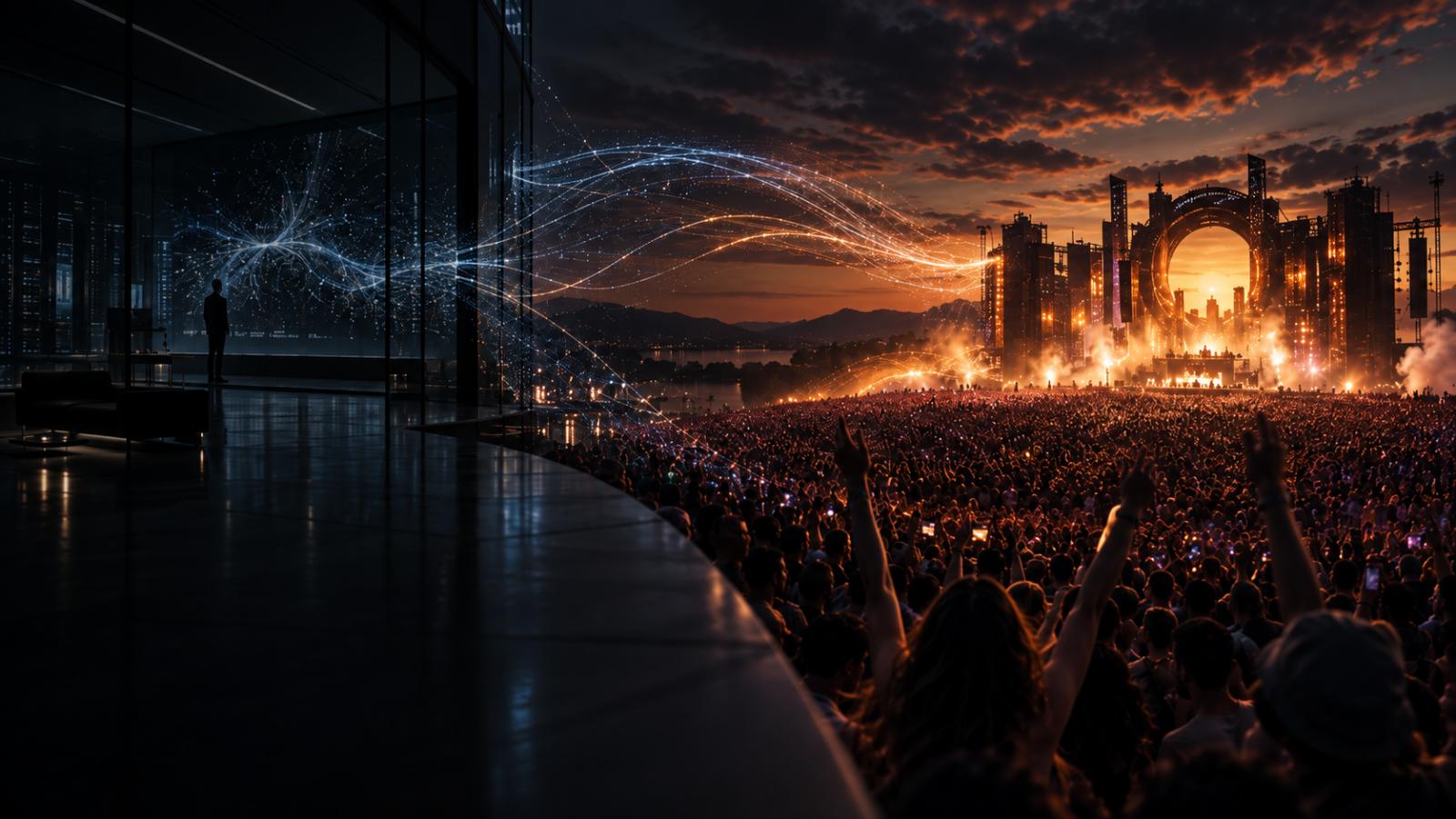
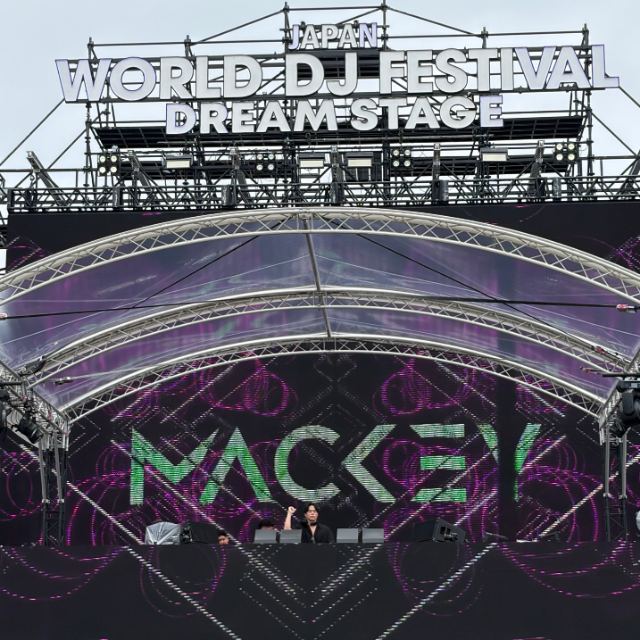
The global electronic music market is growing.
Japan's live entertainment market and its music festival market have both hit record highs.
And yet, in the UK, more than a third of nightclubs have disappeared since 2020. In Berlin, the dance floors are full, but the clubs are struggling to stay in business.
At first glance, that looks like a contradiction.
It isn't that people have stopped listening to music. It isn't that they've stopped wanting to dance. It isn't that they've stopped wanting to gather in real places.
If anything, we may be making a big mistake about what is actually happening.
What is declining is not the dance floor.
What is in danger is the conventional nightclub format, built on three assumptions: "late at night," "alcohol," and "a fixed box."
I want to think this through using the numbers from around the world and Japan, and what I have seen myself in Tokyo's clubs.
Electronic music itself is actually growing
Let me start by confirming the basic premise.
Dance music is not in decline.
According to the "IMS Electronic Music Business Report 2025/26," published by the International Music Summit and MIDiA Research, the global electronic music industry in 2025 was worth $15.1 billion, up 7% from the previous year.
In other words, demand for electronic music itself has not disappeared.
Ibiza is even more interesting.
In 2025, club ticket sales in Ibiza reached €160 million.
And the number of events itself went down.
Fewer events. More revenue.
IMS reads this as demand concentrating on higher-value experiences.
I think this is a pretty telling sign for thinking about the club market from here on.
Not going to a club every week without much thought.
But rather,
"I'm going because that DJ is playing."
"I'm going because it's that party."
"I want to go all the way to Ibiza for this experience."
If demand is shifting in that direction, then it is no contradiction for the electronic music market to grow while only ordinary club operations struggle.
In fact, it's natural.
In the UK, 36% of nightclubs have disappeared
There is a country where this shift already shows up clearly in the numbers.
The UK.
According to the Night Time Industries Association's 2026 report, the UK has 823 nightclubs left.
That is a 36% drop since March 2020.
At the same time, the UK electronic music industry generated £2.47 billion in economic activity in 2025.
Even more interesting, while the number of club venues fell 36%, electronic music events rose 10.5%.
You couldn't ask for a clearer set of numbers.
Electronic music events go up.
Clubs go down.
The idea that "if electronic music is popular, the nightclub as a business will automatically thrive" has already broken down.
The same goes for 2023. UK electronic music club visits were estimated at about 90 million, down 9% from the year before. The clubs' economic contribution fell 14%, while the festivals' contribution rose 9%.
Demand for music is flowing somewhere other than clubs.
Global electronic music industry (2025)
$15.1 billion
+7% year on year
Nightclubs in the UK
823 venues
−36% since March 2020
Electronic music events in the UK
+10.5%
Over the same period in which clubs have been closing
Have young people "stopped going out"?
This is where the usual explanation comes up.
"Young people these days don't go out."
"They don't drink."
"They just stare at their phones at home."
But that alone doesn't explain it.
In the UK, it has been reported that the cost of living, safety, and late-night transport are all affecting how often young people go out.
In other words, it's not that
"young people have come to hate music."
It's better to think that
the cost of going out late at night has gone up.
Even if a club's entry fee is 5,000 yen, the real cost is not 5,000 yen.
There's transport.
There's the drinking.
If you miss the last train, there's a taxi fare.
You can't get home until morning.
Your sleep gets wrecked.
The next day is lost.
At 20 you may not care, but by 30 or 40 you have work or family plans the next day.
So the real price of a late-night club is
entry fee + food and drink + transport + the time you lose the next day.
Even if you're seeing the same DJ,
will you see them from 5 p.m. to 10 p.m. on a Sunday,
or from 1 a.m. to 5 a.m. on a Saturday night?
The music is the same, but the cost the consumer pays is completely different.
In Berlin, "the customers are there, but the money isn't"
There is even more interesting data coming out of Berlin, the center of club culture.
In a 2026 survey by Clubcommission Berlin, 83% of responding clubs and event organizers reported occupancy of 50% or more.
A third of them reported 75% or more.
In other words, it's not that the floors are empty.
And yet the business picture is tough.
In 2017, 79% of respondents were at least breaking even, but by 2025 that had fallen to 61%.
Put the other way around, about 40% of respondents were running at a loss.
Note that this survey is based on 102 valid responses from Berlin clubs and event operators, and is not a complete count of all clubs.
The customers are there.
And still there's no profit.
Why?
One answer is alcohol.
In 2017, food and drink made up about 60% of revenue at Berlin clubs, and entry fees made up 21%.
By 2025, that had completely reversed.
Entry fees: 59%.
Food and drink: 20%.
73% of operators felt their customers were drinking less alcohol, and 60% confirmed an increase in non-alcoholic drinks. 57% said customers were staying for a shorter time.
This is a hugely important change.
Alcohol used to be what supported the DJs, the sound system, and the lighting.
Draw people in with music, keep them there for a long time, and make the profit at the bar.
But that model is getting weaker.
A full dance floor and a profitable late-night box are not the same thing.
2017
2025
Alcohol, the huge profit engine, is weakening
This change is not limited to Berlin.
According to IWSR, sales volume of no/low alcohol products in the 10 major markets, including Japan, grew 13% in 2024.
Over the two years from 2022 to 2024, 61 million new people joined the non-alcoholic market.
In addition, 64% of consumers in the 10 major markets say they are cutting back on drinking, and among Gen Z of legal drinking age, that figure reaches 75%.
Of course, this is not the simple story that
"young people don't drink anymore."
There will still be people who drink.
There are still people who want to get drunk and dance late at night.
What matters is that
building a club's business around customers who stay for a long time and drink many drinks is no longer as safe as it used to be.
The floor is made by ordinary guests, and the profit is made by VIPs
There is one more thing we can't avoid when thinking about today's large clubs.
VIP.
From the point of view of someone going to a club, VIP just looks like "expensive seats."
But from the operator's side, it means something completely different.
While ordinary guests pay a few thousand yen to enter the floor, a single VIP table can move hundreds of thousands of yen, sometimes millions.
Several bottles of champagne are opened.
Expensive bottles come in.
The party moves up to a bigger table.
Birthdays and anniversaries bring in huge orders.
Think about a single night's revenue, and
one VIP table can be worth 100 or even 200 ordinary guests.
Here we see a slightly odd structure in today's large clubs.
The one who gets the floor going is the crowd of ordinary guests.
But
the one who makes the profit is the small number of VIP guests.
Without the ordinary guests, there is no club.
A packed dance floor.
The heat.
The cheers.
Chance encounters between people.
Footage spreading on social media.
The reputation that "that place is hot."
All of this is basically made by the crowd on the floor.
But you can't charge all of those people a high price.
Raise the entry fee too much and the customers disappear.
The model of getting people to drink many drinks is not as strong as it was.
Meanwhile, a large club carries huge fixed costs.
Rent.
Staff.
DJs.
Sound.
Lighting.
Visuals.
Production.
Security.
Equipment.
Trying to cover all that with entry fees of a few thousand yen means gathering an enormous number of people every single night.
That is why the bigger the club, the more it turns into a structure where
a large crowd of ordinary guests creates the space, and a small number of VIPs deliver the big revenue.
To put it another way,
it is no longer a business where "a full house means profit."
Even if the floor is packed, revenue doesn't grow much if it's all ordinary guests.
Conversely, if several VIP tables fill up and hundreds of thousands or millions of yen move there, the whole structure of the night's revenue changes.
At the extreme, there are even clubs where
whether the VIP is full matters more to the business than whether the floor is full.
I think this is a rather fascinating contradiction for club culture.
The people on the floor create the heat of the venue.
Seeing that heat, VIP guests come to the venue too.
But what supports the venue economically may be the VIP guests.
In other words,
ordinary guests create the value of the product, and VIPs pay a high price for it.
In a sense, it's close to a giant festival.
Because tens of thousands of people are there, a giant surge of energy is born.
Because that energy itself has value, VIP, premium areas, special seats, and special experiences can be sold at high prices.
So VIP is not just an add-on service.
It is becoming the business model of large-scale nightlife itself.
And the more alcohol consumption falls and costs rise, the more dependence on it grows.
What can no longer be earned broadly and thinly from alcohol is taken narrowly and deeply from VIPs.
Seen that way, it's natural that large clubs recently emphasize VIP.
But there is a risk here, too.
Add more VIP areas and revenue becomes easier to raise.
But add too many VIP areas, and the dance floor shrinks.
The tables become bigger than the floor.
It becomes a place to sit and open bottles rather than a place to dance.
In the end, it comes closer to
a giant VIP lounge with a DJ, rather than a "club."
Here too, culture and economics are slightly out of step.
The floor creates the culture.
VIP creates the profit.
And ironically,
to keep the dance floor alive, we need the money of people who don't dance on the dance floor.
I think this is also one of the structural changes the club, as a business format, is facing today.
So what about Japan?
From here it gets even more interesting.
In the UK, the decline in clubs has already become a number.
Japan, though, is the opposite.
According to the National Police Agency, the number of "specified entertainment and dining establishments" was 404 at the end of 2019.
At the end of 2025, it was 592.
In a simple comparison, that is an increase of about 46.5% over six years.
That said, the 592 includes not only nightclubs but also show pubs, live music venues, and others.
So if we look at nightclubs alone from 2021 onward, when a breakdown is available,
2021: 339 venues
2022: 365 venues
2023: 382 venues
2024: 418 venues
2025: 433 venues
That is a 27.7% increase over the four years from 2021 to 2025.
The National Police Agency itself says the number of permits for specified entertainment and dining establishments has been "increasing continuously in recent years."
At least looking at the number of venues,
Japan's nightclubs have not decreased.
If anything, they are increasing.
- 3392021
- 3652022
- 3822023
- 4182024
- 4332025
So is Japan's club market doing well?
I doubt that.
Perhaps Japan is heading toward the same problem as the UK, but in a different order.
That is,
perhaps we are not at the stage where the boxes are disappearing, but at the stage where there are too many boxes.
Of course, there is no nationwide statistic that directly proves "Japan's club market is oversupplied."
There is almost no reliable national data on total annual club attendance, or on the average occupancy rate across all venues.
So for now this is a hypothesis.
What we can confirm, though, is that supply is growing.
Meanwhile, looking at late-night alcohol-serving establishments as a whole in the same National Police Agency statistics, the count went from 261,149 in 2021 to 258,163 in 2025, roughly flat to a slight decline.
It's not that all nightlife venues are exploding in number.
Within that, the number of nightclub permits is rising.
If so, I think we should consider
the possibility that the supply of clubs is growing faster than demand.
10 to 15 years ago, a weekend in Roppongi was an event in itself
From here, it's not about statistics but about my own memory.
About 10 to 15 years ago.
When I was out partying in Roppongi in the early 2010s, the weekend scene looked quite different from today.
Late at night, the streets of Roppongi themselves overflowed with people.
There were lines in front of the clubs.
And not only on days when a special world-class DJ was playing.
An ordinary Friday.
An ordinary Saturday.
Even then, the people were there.
As I felt it at the time,
"It's the weekend, so I go to Roppongi."
"I just go to a club."
That kind of behavior was far more natural than it is now.
Of course, this is not market statistics.
It is my own memory of what Roppongi looked like then.
So I can't conclude from this experience alone that "Japan's club market was bigger in the early 2010s."
But the gap with the scene I see now, as a club DJ in Tokyo, is large.
There are still nights when people gather.
If anything, long lines form on days when a famous overseas DJ is playing, or on big-event days.
So it's not that people have stopped dancing.
To me it looks like
we have moved from an era when the weekend itself was the purpose to an era when people don't move unless there is a "reason to go that day."
Put another way,
the club that used to be part of everyday life has become an event.
Isn't it getting harder in Japan to fill a big venue on an "ordinary weekend"?
This too is not a statistic, but a field observation from my own experience DJing in Tokyo clubs.
These days, it feels quite hard to fill a big venue just because it's a Friday or a Saturday.
On the other hand, on days when a famous overseas DJ plays, people clearly show up.
A big name visiting Japan.
An anniversary event.
A strong collaboration.
Special production.
Customers concentrate on days that have
"a reason you have to be there today."
Conversely, it isn't easy to keep generating the same heat every week with regular operations centered on domestic DJs.
Again, this is not a national statistic.
It is simply my own observation as someone in the field at Tokyo clubs.
But if this feeling is right, it means something quite important.
Customers haven't stopped going to clubs.
They only go on "nights with a reason to go."
If you can't fill the room without booking overseas DJs, what are the customers attached to?
Booking famous overseas DJs is not a bad thing in itself.
On the contrary, being able to see the world's top artists in Tokyo is good for the scene.
The problem comes when
the room can't be filled without it.
If regular nights can't draw enough people to a big venue, and large crowds come only on nights when an expensive overseas artist is booked,
then what the customers are attached to is
not the venue.
It is the DJ, the event, the IP.
Consumption is shifting from
"I'm going because it's this club"
to
"I'm going because of that DJ,"
"I'm going because of that event,"
"I'm going because it's the only day I can see it."
This overlaps with what's happening in Ibiza, where the number of events is falling while ticket revenue rises.
It's not that demand has disappeared.
Demand is concentrating on "special nights."
Oversupply is especially dangerous for clubs
Suppose a city has 10,000 people who go to clubs.
With 10 clubs, that's an average of 1,000 per club.
With 20 clubs, it's 500.
That's obvious.
But there is a big difference between a restaurant and a club.
If a 100-seat restaurant has only 50 customers, the taste of the food itself doesn't change.
But if a club with a capacity of 1,000 has only 200 people,
the product itself changes.
The floor is empty.
It doesn't look lively.
There are fewer chance encounters between people.
Even if the same DJ plays the same set, the experience is different.
The scene that shows up on social media is weaker too.
And people who see that footage don't want to go next time.
In other words, at a club,
the presence of customers is itself part of the product.
That means a negative network effect can occur:
Supply increases.
Customers get spread thin.
The floor gets thinner.
The value of the experience falls.
Repeat visits decrease.
The floor gets thinner still.
The club is a business format that is quite vulnerable to oversupply.
Even so, Japanese people have not moved away from musical experiences
Here is an important counterexample.
The explanation that
"Japanese people have stopped going to live music events"
is not supported by the numbers.
According to Pia Research Institute, Japan's domestic live entertainment market in 2025 was 856.4 billion yen.
That is up 12.6% from the previous year.
It was a record high for the third year in a row.
Attendance rose 7.7% to 92.23 million.
Spending per person also rose, to 9,286 yen.
In other words, people
have not stopped spending money on experiencing music and entertainment in real places.
If anything, the market is growing.
Festivals are at record highs too
The same goes for music festivals.
In 2025, Japan's music festival market was 46.5 billion yen.
That is up 7.0% from the previous year.
Attendance rose 3.1% to 3.71 million.
Both market size and attendance set new records for the third year in a row.
But we must not misread this.
These figures include not only EDM and techno but also rock, J-pop, and more.
So they are not numbers that prove that
"dance music is growing in Japan."
What this data shows is something broader.
Large numbers of people gathering to experience music is not declining at all.
If only clubs are struggling,
the problem is not "people losing interest in music."
Isn't it in the design of the club as a product?
Why do people go to festivals?
Festivals have an obvious "reason to go."
It's only on that day.
A huge number of artists play.
There are giant stages.
You travel with friends.
You take photos and videos.
It becomes a memory of that year.
In other words,
the event itself is the destination.
A club that opens every Friday and Saturday, on the other hand, has to keep creating
"a reason you have to go this week,"
every single week.
That is extremely difficult.
There's next week.
There's the week after.
You can go anytime.
A place you "can go to anytime"
is also a place you can keep not going to forever.
That is why things change when a famous overseas DJ comes.
Scarcity appears:
"If I miss today, I don't know when the next chance will be."
Ibiza shows us "fewer, pricier, stronger"
So let's look at Ibiza once more.
The number of events fell.
Ticket sales rose to €160 million.
Here we can see one possible future.
Rather than operating in volume,
create a strong reason for each and every night.
World-class DJs.
Strong residents.
Party brands.
Overwhelming production.
VIP.
The resort.
Travel.
A worldview.
An experience you can get nowhere else.
This is no longer simply a "box" business.
It is closer to an IP business.
Tomorrowland is the same.
People don't fly in from all over the world because they want to see a piece of land in Belgium.
They travel to go to the world of Tomorrowland.
The brand comes before the place.
Japan's clubs will also move from "boxes" to "IP"
I think Japan will go in the same direction.
Until now,
"A giant club opened in Roppongi,"
"A new big venue opened in Shinjuku,"
were news in themselves.
The box was scarce.
But as boxes increase, their value naturally thins.
If there are several similar clubs in the same city,
"big,"
"good sound,"
"amazing lighting"
are no longer enough.
So we have to reverse the subject.
It is not the club that owns the party.
It is the party or the community that uses the club.
There is a strong brand.
There are people who love that brand.
One day it's held at a club.
In summer, outdoors.
Another day, in the early evening.
Sometimes in the morning.
Once a year, a large-scale edition.
Even overseas.
What the customers are attached to is not an address but the brand.
From a venue business to an IP / community business.
The field sense that it's hard to fill the room without foreign headliners connects here too.
Rather than borrowing a huge IP, a famous overseas DJ, every time,
the club or the party itself needs to become the "reason to go."
Will mornings take clubs' customers?
Another change happening now is in the hours people dance.
So-called daytime parties, coffee raves, morning raves.
In Tokyo, too, there are morning events like Tokyo Morning Beats, which combine house music, coffee, and running.
According to its official website, it is held on weekend mornings with 100 to 200 people, and in July 2026 it has also scheduled an event with a capacity of 400 at ADRIFT in Shimokitazawa.
It is too early to look at this alone and say
"clubs will lose out to morning events."
The scale is still small.
But it proves something very important.
People can dance even in the morning.
It's obvious, but for a long time club culture sold
dance music.
Darkness.
Alcohol.
Late night.
Coming home in the morning.
as one set.
But in fact, not all of that was ever necessary.
It's fine to listen to house at 9 a.m.
It's fine to listen to techno at 3 p.m. on a Sunday.
It's fine to dance from 6 p.m. and go home at 11 p.m.
It's fine not to drink.
It's fine to go to the gym the next morning.
In other words,
the night is beginning to lose its monopoly on "the time for dancing."
Even so, late night has things only late night has
That said, I don't think morning raves will become the final form of the club.
There is culture that doesn't work in the morning.
The anonymity of late night.
Darkness.
Sexuality.
A sense of danger.
The feeling of being temporarily cut off from society.
The solidarity that comes from the very fact that music is still playing at 5 a.m.
These too are part of club culture.
They can't be replaced by an event where you listen to house with a coffee at 9 a.m.
So,
late night will absolutely remain.
But
the monopoly that says "if you're going to dance, it has to be late at night" will disappear.
That difference is a big one.
Inbound tourism makes Japan's clubs a little special
Japan has one more big variable.
Inbound tourism.
Visitors to Japan in 2025 numbered 42,683,600.
Up 15.8% from the previous year, a record high.
For clubs in Tokyo and Osaka,
"Japanese young people are decreasing, so demand will fall too"
is not enough to explain the market.
If, for overseas travelers,
Tokyo's nightlife itself becomes tourism content, that changes things.
Clubs with global recognition.
Parties you can only see in Japan.
Japan's own DJs and subcultures.
Places people say they want to visit "now that we're in Tokyo."
There is room for growth there, separate from domestic demand.
So I don't think the future is one where all of Japan's clubs shrink uniformly.
The most endangered may be the "ordinary club"
What I think is most in danger
is not the super-large clubs.
It is not the small underground boxes either.
It is the "ordinary club" in between.
A super-large venue can have weapons like
famous overseas DJs.
VIP.
Tourists.
Huge production.
A brand.
On the other hand, a small party of 100 or 200 people can work with just a strong community, built on
"I love this sound,"
"I want to meet these people."
What is in danger is a place that
has no special IP.
Has no tourist value.
Has no strong community.
But still has to open every week.
In the UK too, the "missing middle", the hollowing out of mid-sized venues, has been pointed out as a problem for electronic music infrastructure.
Giant IP and strong niches.
When a market matures, the middle gets squeezed.
Clubs may be no exception.
Clubs will stop selling "opening hours"
Club management until now has been tightly bound to place and opening hours.
Open on Friday night.
Stay open until morning.
Open on Saturday too.
Repeat every week.
If you have a venue, you owe rent.
So you open even on days when demand is weak.
But the dance music business of the future can be more fluid.
One day, late at night.
Another day, in the early evening.
Another day, in the morning.
Outdoors in summer.
A few times a year, gather several thousand people.
Normally, run it at 300.
Hold events in other cities too.
Go overseas, even.
What customers follow becomes
not an address but a worldview.
More important than owning a box
is having a relationship with your customers.
If alcohol declines, we have to earn from something other than alcohol
The problem the Berlin numbers show can't be avoided either.
If drink sales weaken, another source of revenue is needed.
If you simply keep raising entry fees, young customers won't be able to come.
So you need multiple revenue streams, such as
VIP.
Premium experiences.
Food.
No/low drinks.
Coffee.
Merchandise.
Brand collaborations.
Sponsors.
Memberships.
Large-scale events.
Travel.
Hotels.
Content.
Artist IP.
Rather than "booking DJs to sell alcohol,"
getting people to pay for the culture and the community itself.
I think things will change in this direction.
Even so, the late-night club will not disappear
So far I've written that "the late-night box will die."
But that doesn't mean all late-night clubs will vanish.
If anything, I think
the late-night club will return to its original form.
It will no longer be the place everyone goes to on a Saturday, just because.
It will be a place for people who truly love that music.
People who want to belong to that community.
People who truly want to dance until morning.
Underground techno.
House.
Gay clubs.
Genre-specific parties.
Small communities.
The underground.
There, even the inconvenience of
"it goes on until 5 a.m."
becomes part of the culture.
It doesn't have to be a mass market.
If anything, I think that's more fitting for a club.
And humans will probably keep dancing
As AI develops further, human life will change dramatically.
AI may take over a large share of work.
AI can create, too.
Video, music, games, all of it may become endlessly enjoyable without ever leaving home.
If you think only about convenience, the reasons for people to go outside will shrink.
But precisely because of that, I think
the value of humans gathering in real places will rise.
Thousands of people in the same place.
Feeling the same kick drum in your body.
Sweating.
Making eye contact with a stranger.
Shouting with friends.
Being bathed in loud sound.
Dancing.
This can't be made more efficient.
It can't be fully transplanted into a screen.
If AI takes over our work and human leisure time grows,
one of the things that remains last
may be
people gathering to play.
The global electronic music industry has grown to $15.1 billion.
Japan's live market has grown to 856.4 billion yen.
3.71 million people gather at Japan's music festivals every year.
In the UK, clubs are declining, yet electronic music events are increasing.
In Berlin, even though business is hard, the floors themselves are full.
Humans still want music.
Humans still want to gather.
And humans still want to dance.
The dance floor won't die. Only the "late-night box" will
I don't think the future of nightlife will move in a single direction.
Giant festivals may get even bigger.
Global club brands will remain.
VIP and premium experiences will grow.
Early-evening events will increase.
Morning raves will increase.
Small community-style parties will remain.
Underground late-night clubs will remain.
At the same time, models like
"we open because it's Friday and Saturday,"
"if we build a club, customers will come,"
"if we get them to drink, we'll make a profit"
will gradually stop working.
In the UK, that change has shown up as the number of venues closing.
In Berlin, it shows up as the struggle to turn a profit even with customers on the floor.
In Japan, for now, it is the opposite: the supply of clubs is growing.
So Japan may not yet be
in the middle of a decline, but at the entrance to oversupply and a shakeout.
What I saw in Roppongi 10 to 15 years ago was
a city where people gathered because it was the weekend.
What I feel now, DJing in Tokyo clubs, is
a city where people concentrate on nights with a strong reason.
If this change is really happening,
the winner from here on will not simply be the biggest club.
It will be whoever has a "reason to make the trip."
That reason might be a DJ.
It might be the music.
It might be the community.
It might be the brand.
It might be travel.
It might be the morning.
It might be the late night.
And the place that makes it happen doesn't have to be a fixed box either.
There is music.
There are people.
Bodies move.
A moment is shared.
As long as that remains,
the dance floor won't die.
If anything is going to die, it is
the old assumption that "if you want to enjoy dance music, your only option is to spend the night in a fixed box late at night, drinking until morning."
Sources
International Music Summit / MIDiA Research, "IMS Electronic Music Business Report 2025/26"
www.internationalmusicsummit.com/news/ims-electronic-music-business-report-2025-26
The global electronic music industry in 2025 at $15.1 billion, up 7% year on year; Ibiza club ticket sales of €160 million; and more.
Night Time Industries Association, "The Fourth UK Electronic Music Industry Report"
ntia.co.uk/the-fourth-uk-electronic-music-industry-report
The UK electronic music industry at £2.47 billion; 823 nightclubs, down 36% from March 2020.
NTIA, "UK Electronic Music Powers £2.47bn"
ntia.co.uk/uk-electronic-music-powers-2-47bn-free-parties-boom-mid-tier-venues-in-crisis-and-the-north-leads-93-growth-new-report-reveals
In the UK, nightclubs fell 36% while electronic music events rose 10.5%.
NTIA, "The Second UK Electronic Music Industry Report"
ntia.co.uk/the-second-uk-electronic-music-industry-report
Electronic music club visits in 2023, and changes in the economic size of clubs, festivals, and others.
Clubcommission Berlin, "Clubkultur Berlin 2026"
www.clubcommission.de/neue-studie-zur-berliner-clubkultur
A survey of 102 Berlin clubs and others. Occupancy rates, profitability, changes in the mix of food and drink versus entry fees, decline in alcohol consumption, and more.
IWSR, "More than moderation: the long-term rise of no and low"
www.theiwsr.com/insight/more-than-moderation-the-long-term-rise-of-no-and-low
Sales volume of no/low alcohol products in the 10 major markets, including Japan, up 13% in 2024.
IWSR, "Moderation: is it generational or universal?"
www.theiwsr.com/insight/moderation-is-it-generational-or-universal
64% in the 10 major markets say they are cutting back on drinking; 75% among Gen Z of legal drinking age.
National Police Agency, "Reiwa 2 Police White Paper"
www.npa.go.jp/hakusyo/r02/index.html
404 specified entertainment and dining establishments at the end of 2019.
National Police Agency, "Status of Adult Entertainment Businesses and Enforcement Against Related Offenses in Reiwa 7"
www.npa.go.jp/news/release/2026/20260407001.html
592 specified entertainment and dining establishments and 433 nightclubs at the end of 2025. The trend in nightclub permits from 2021 to 2025, and more.
Pia Research Institute, "2025 Live Entertainment Market"
corporate.pia.jp/news/detail_live_enta_market20260617.html
Domestic market of 856.4 billion yen, attendance of 92.23 million, spending per person of 9,286 yen.
Pia Research Institute, "2025 Music Festival Market"
corporate.pia.jp/news/detail_piasoken_fesdata_20260703.html
Market size of 46.5 billion yen, attendance of 3.71 million. Note that this is a statistic for music festivals as a whole, including rock, J-pop, and others, not limited to dance music.
Tokyo Morning Beats
tokyomorningbeats.com
A Tokyo example of morning raves / coffee raves. Held on weekend mornings with 100 to 200 people.
Japan National Tourism Organization (JNTO), "Visitor Arrivals to Japan in 2025"
www.jnto.go.jp/news/press/20260121_monthly.html
42,683,600 visitors to Japan in 2025, up 15.8% year on year, a record high.